
The Hugo Burger

20140601-175734-64654455.jpg

I NAMED my signature burger after my furry son – Lord Hugo of Rozelle and Balmain – as it’s strong, mischievous and bold just like him.

I’m having a bit of a burger craze at the moment ever since I got back from the USA last year and have been mixing up burger options at home. After much thinking through ingredients I have come up with The Hugo – more of an American-inspired burger than the good old Aussie fish ‘n’ chip shop style.

The Hugo Burger is a grilled blue cheese-infused meat patty seasoned with a few seasonings and topped with tomato, lettuce leaves, pickles and caramelised onions on a toasted bun with a squirt of sriracha-blended mayo (or some good tomato relish).

One thing I have learnt is that you can’t muck around when preparing burgers – you have to use fresh ingredients – starting with the meat. I use minced sirloin (you need at least 10 to 15 per cent fat content). If you can’t get to a butcher to mince it for you or you can’t do it yourself then premium supermarket mince can do.

When making the burgers there are a few tips you have to keep in mind so that they come out juicy and tender:

  1. Don’t over knead the mince or your burger will be tough.
  2. Make sure the meat is cold and not warm and your hands are cold when you knead – you want the fat to stay in the burger and not get stuck on your hands.
  3. Make an oval-sized depression at the centre on the burger as this helps the burger to maintain its rounded shape as it expands when cooking.
  4. Sprinkle a pinch of salt evenly over each burger just before grilling. Only use salt before cooking as salt can affect the proteins in the meat causing the patty to break up and go ‘mushy’.
  5. Cook the burger straight after making (or from resting in the fridge) as it will hold together a lot better.

And now I present you with ingredients to make the Hugo Burger:
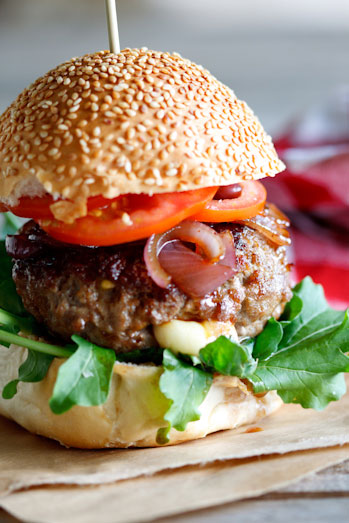
Hugo BurgerTHE BURGER
1 kg beef mince
1 small red onion, peeled and finely chopped
100g blue cheese, crumbled
100 grams of hot pancetta, chopped
1 teaspoon of dried tarragon
1 tablespoon of stuffing mix (Tandaco brand)
2 teaspoons Worcestershire sauce
1 teaspoon Dijon mustard
Sea salt and black pepper

TO SERVE
6 to 8 soft burger buns, split and toasted
A handful of rocket leaves
Sliced tomatoes and dill pickles (sliced lengthwise)
Caramelised onions (three large red or brown onions)

Sriracha mayonnaise or tomato relish (or even Turkish Ajvar spread).

METHOD

Mix the mince with all the burger ingredients expect the crumbed cheese. Once mixed thoroughly (remember not to over knead or the burger will be tough), add the crumbed cheese and gently fold in and then divide into six or eight patties. Make a small oval depression on the top of each patty.

Crank up the grill and while this is warming  slice up some brown onions into rings and caramelise them using some butter and a little salt in a saucepan on the stove and then set aside. To make the sriracha mayo get some everyday quality mayonnaise and add sriracha sauce (I only use Huy Fong Sriracha), bit by bit to your taste. An alternative is some good tomato relish or quality ketchup

Grill your burgers to your liking. Make sure the grill is hot an you oil the grill. Place each burger on it – a high heat will ensure a good crust around the burger. Avoid flipping too often or pressing down on the burger as you want to keep all the flavour and juices inside. Flipping once is ideal – about four minutes ion each side is fine. I use a Weber kettle or Weber Q for my grilling and I tend to put the lid down for a few minutes to round the burger off after the first flip to ensure the blue cheese is melted inside. Like with all meat – allow the burgers to rest.

Once rested place the grilled burgers on the bottom burger bun and then top with tomato, rocket leaves and sliced dill pickles. Top with the caramelised onions and smear the top of the bun with the sriracha mayo or your favourite sauce.

Serve with a side of fries or coleslaw.


Posted in Uncategorized | Tagged | Leave a comment

Hot Star Chicken (Sydney)

Hot Star 2HBV was pretty excited to learn recently that the iconic Taiwanese chicken joint, Hot Star, had landed in Sydney.

Hot Star is possibly one of the most flocked to fast food joints in Taipei. It started in Taipei’s famous Shilin night market serving Taiwanese fried chicken steak which is one of the better “junk foods” on the planet.

As mentioned in a previous blog, fried chicken steak or XXL chicken, is a flattened chicken breast coated in a mixture of tapioca flour and spices and then deep-fried. I have read that Hot Star in Australia uses locally-sourced chickens with all of its other ingredients (like flour and spices)  imported from Taiwan in order to replicate the flavours of its famous product sold in Taiwan.

I didn’t want to venture to Sydney’s Hot Star alone so I enlisted The Apprentice to make the sojourn with me for lunch. The Apprentice knows his fried chicken. He used to live on the American friend chicken stuff so much so that he was once the splitting image of Meatloaf. After some hard yakka (and cold turkey resisting The Colonel’s eerie smile), he now has the figure of Leonardo. Dragging him along took some coaxing because he thought that one whiff may lead to a fried chicken bender where there would be no escape.

Hot Star - CrowdSydney’s Hot Star Chicken is set in a small street front space with just enough room for staff to cook, season and bag, and when we arrived at its Liverpool Street store there was already a queue along the street. The menu features the Large Fried Chicken ($7.90) but also some sides (for smaller appetites who don’t want to go XXL or those who want to really increase their cholesterol levels and have then as an accompaniment). These sides are curly fries ($3.90); chicken bites ($5.90); fried sweet potato ($3.90) and fried mushrooms ($4.90). You can get a XXL chicken and a soft drink combo for $9.90.

I ordered the large fried chicken (spicy) while The Apprentice ordered a combo – a drink and a large fried chicken (original flavour).  Within about five minutes our numbers were called and the flattened 250g chook breasts were put into a paper bag and then placed in a carry bag for us to take away.

Hot Star - ChickenThe Apprentice went into a cold sweat as soon as he saw the enormity of the task he was to undertake – I forgot to tell him that Hot Star Chicken is about the size of your face (it’s at least 30cm long). He attempted it and left half. I, on the other hand, managed to get through mine (just). It was true to form – the batter was crispy and well seasoned and succulent and juicy inside. The spicy powder gave it a good hit – but I think I prefer having the original as the chilli can be a bit overwhelming when indulging in such a large piece of fried chicken. It would be ideal if you could get a half and half.

So, was it true to Taiwanese form? Yes, it brought back memories of the original experience at Shilin, but after such a feat I will need to wait at least six months for my cholesterol to lower before undertaking the task again (or sooner if I take up weigh-lifting and need a protein boost). As for The Apprentice, he has just got out of rehab.

The verdict: The Apprentice can’t believe Taiwanese don’t have physiques of Samoan rugby players. I’m happy to see yet another Taiwanese favourite come to Australia.

What: Hot Star Chicken, 6 Liverpool St, Sydney NSW 2000. Open Sunday to Thursday from 11am to midnight and Friday and Saturday from 11am to midnight. www.hotstarchicken.com.au/

Ate there: April 2014.

Posted in Casual dining, Hawker food, New South Wales, Street Food, Sydney, Taiwanese | Tagged , , , , | 2 Comments

Temasek

I SPENT  some time on and off  in Singapore during my formative younger adult days and as part of that experience I learnt about the painstaking art of preparing Nyonya (Peranakan) cuisine. I say painstakingly because I was told at the onset at all my Nyonya cooking lessons that Nyonya dishes are prepared with love rather than “out of love” because of the time and trouble you have to go to prepare meals.

Peranakan is a term used for the descendants of Chinese/Malay “Straits Chinese” with the terms Nyonya referring to Peranakan women and Baba referring to Peranakan males. Peranakan cuisine is based on using Malay cooking techniques and blending distinctive Malay spices with Chinese ingredients. It’s also called Nyonya cuisine because it is the women who usually prepare and cook all the meals in the Peranakan household.

Temasek -LaksaLaksa is possibly the best known of the Peranakan dishes. It comes in a few varieties – Assam laksa uses a tamarind soup base and laksa lemak is a coconut curry soup. In Singapore the variety is laksa lemak (or aka curry laksa), and is typically an infused coconut broth containing clams, prawns, fish cake, bean sprouts, tofu and egg with rice noodle – all topped with laksa leaf and sambal. The east coast suburb of Katong is the best place to try it in Singapore and is home to fierce competition between laksa stalls. This rivalry, which has been coined the “Katong Laksa War”, has Singaporeans regularly reporting and blogging who is making the best laksa in the area (which has resulted in some stalls closing if they don’t make the grade).

The typical Australian version of laksa tends to be a laksa lemak with either prawns or chicken or a combination of both (anything else such as beef is a  bastardization of the dish in my book), with the usual bean sprouts and fried tofu and fish cake with vermicelli or egg noodles.

Laksa has to be made well and the difference between a great laksa and a fair laksa is the paste and the stock.  As my Nynoya teachers told me it’s also got to be made with love. I was taught that every ingredient for the paste should be pounded in a mortar with each ingredient added one at a time to blend and be smashed painstakingly for up to an hour (smashing is better than using a food processor as it just cuts the ingredients). One of my Nynoyas said with all the effort it took to make laksa it had to be love that drives you and another proudly proclaimed the constant smashing and pounding was also good for stress relief – (i.e. she would rather smash spices and herbs than her baba). After completing the paste the making of the stock is the next big step with the simmering of prawn shells or chickens. Finally, every bean sprout must be detailed as the stringy tails are bitter and don’t meld well with the finished product.

Unfortunately, in Australia, laksa is usually made with commercial pastes. Not so at one busy restaurant which I believe makes one of the best laksa in Australia – Temasek in the western Sydney suburb of Parramatta.

Temasek is the Malay word for Singapore and the restaurant is tucked in a narrow arcade that runs along the restored art deco Roxy theatre. It’s a bit reminiscence of a lane way Asian restaurant with every square metre taken up by a table or seat and is sparsely decorated with a few framed Singapore tourism posters adorning the walls.

Temasek TeaI popped into Temasek for a quick lunch one weekday and got there deliberately early (around noon), knowing from past experiences it would get busy. Already the place was seething with office workers and families but I was able to get the last seat (a small table for two outside in the lane).

The menu features  some classic Hawker stall gems besides laksa: Hainanese chicken rice ($16.80); mee siam ($11.80); fried Hokkien prawn mee ($13.80); char kway teow ($12.80) and  mee goreng ($13.80). I made the effort to come to Temasek for one dish only – prawn laksa ($14.80). I also ordered an iced lemon tea ($3).

You can tell before you take your first sip that Temasek’s laksa is going to be good. Glancing into the bowl before you are chopped green laksa leaves and smashed up other fragrant goodness floating in the soup. The sprouts have been detailed and the stock smells that it’s been made with love. The broth is spicy and sweet with hints of galangal, onion, chilli and shrimp paste. The bowl has a good clump of fried tofu, king prawns,  fish cakes and thin rice noodle (essential as the pastes solids stick to the fine noodles making it a wonderful mouthfill) . A topping of spicy and char-flavoured sambal paste is delightful when mixed into the soup.

The iced tea is reminiscent of the teas from drinks stalls in Malaysia or Singapore – icy and sweet with a nice tang . It’s perfect for a warm day and helps round out the palate when eating spicy food.

Service at Temasek can be slightly hit and miss – especially when staff are trying to serve a full restaurant and deal with the bedlam of people queuing for a spot – but if you like Hawker food or want to be reassured that people can serve up a decent laksa outside of Singapore – Temasek should be visited.

The verdict: Sydney’s, if not one of Australia’s, best laksa. Be prepared to queue. It’s the food that counts and not the decor.

What: Temasek, Roxy Arcade, 71 George St, Parramatta. Phone (02) 9633 9926. Open Tuesday to Sunday for lunch from 11.30am to 2.30 pm and dinner from 5.30pm to 9.30pm.

Ate there: April 2014.

Posted in Chinese, Hawker food, Malaysian, New South Wales, Singaporean, Sydney | Tagged , , , , , , , | 2 Comments