Nilgiri’s

Nilgirlis - AjoyAJOY Joshi is an Indian guru (well, he’s mine anyway). He is passionate about his former country’s cuisines (and I say cuisines because if you think Indian food is all the same then you are sadly mistaken as India has 28 regional States), and about cricket.

I remember fondly taking Ajoy to the SCG to see India play Australia in a Test Match many years ago. There he was donning an Akubra hat in the Members’ Pavilion and enthusiastically rising out of his seat cheering whenever India scored a run (or when Australia only hit a four or a six), and passing around his sandwiches with his home-made Indian chutney to the delight of Members.

But it is with the greatest admiration that I remember his teachings, and as most gurus do, they open your eyes.

My epiphany into Indian cuisine began when my guru Ajoy explained there were two mantras that he was taught by his guru named John when he first trained as a Chef that he had to pass on to me. They were:

  1. Know how much salt to add to each of your customer’s dishes (as salt signifies life and the only time it isn’t added is for food at funeral “wakes”).
  2. Never pass on your secrets to the white man.

Ajoy classesAjoy mastered the first mantra but thankfully for me (and other young grasshoppers), he rejected the second. He is an enthusiastic teacher and not only enjoys demonstrating his techniques and sharing his secrets but he ensures that you must understand the cultural, religious and medicinal significance of the cuisine he has mastered such as Ayurveda, the traditional system of Hindu medicine based on the belief that all foods have different properties which can have a direct effect on health and well-being.
Nilgiris GaneshaAjoy holds monthly classes in his St. Leonards restaurant, Nilgiri’s, is the author of four cooking books, was invited to be one of only 10 chefs in the world to contribute to the first comprehensive guide to Indian cooking: India Cookbook; has appeared on TV food shows, has a range of ready-to-cook products, and is an avid blogger.

But foremost he is the guru in the kitchen and possibly one of the most talented Indian chefs in the country. His monthly menus are a showcase of 100s of Indian regional varieties (and from dining at Niligiri’s with my parents for close to 10 years you get to appreciate the fact that he knows them all).

I dined there with the Baroness one February evening and the charismatic Ajoy greeted me at the door as an old friend does even though we hadn’t seen each other in a number of years.

There are many parts to Nilgiri’s.

Tiffin 2As you enter you will notice to the right a small space (The Tiffin Room), which is where Ajoy has his thali set meals as well as dosai. In India Tiffin refers to snacks eaten in-between meals as well as those cylindrical steel metal containers packed with a worker’s lunch and delivered by a tiffinwala. For lunch and dinner you can go to Nilgiri’s and get a pretty damn good vegetarian or meat set with naan and rice (or one of Ajoy’s renowned dosa). It’s casual and quick dining for those who want to enjoy a taste of Nilgiri’s on the hop and without the formality. And, if you really are pressured for time, you can grab one of Ajoy’s Nilgiri’s @ Home range of ready-to-cook meals from the cooler or a jar of his famous date and tamarind chutney at the opposite wall.

Behind the reception area is the restaurant’s largest banquet room which can seat over 80 guests.

Nilgiris - RoomBut it is upstairs where most diners will have their Nilgiri’s experience.

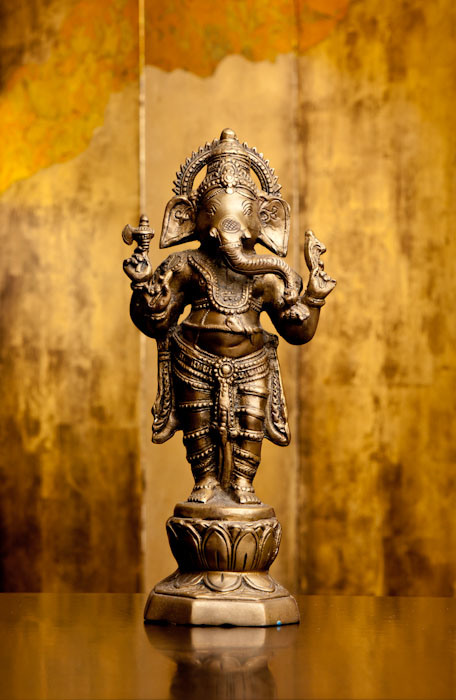
Immediately you will notice the decor – it is painted in what could be described as a turmeric yellow tone which gives the whole restaurant a warm and calming glow. Of course, this decor is deliberate as turmeric has a special significance in Ayurvedic medicine as it is revered as a healer and prevents many ailments. It is also used in India as a skin cleanser and has wonderful antiseptic qualities. Many people gargle fresh turmeric juice and warm water for colds and fevers or take it as a herbal remedy to prevent such. When powered and added to food it becomes a natural colour enhancer – try a sprinkle of it on spinach or on tomatoes – it will bring out the greens and reds of the dish without spoiling the flavors. Throughout the restaurant you will also notice Ajoy’s wonderful eclectic collection of effigies of Ganesha (the remover of obstacles and God of beginnings) – big, small and tiny.

Upstairs also houses four, beautifully-appointed private rooms that can seat from 8 to 14-odd guests.

Tonight’s menu featured 11 entrée (five vegetarian) and 14 main course dishes (five vegetarian). Some of the entrée highlights included chicken tika (fenugreek spiced chicken thigh cooked in the tandoor – $17); seekh kebaba (skewers of lamb mince spiced with garam masala, fresh coriander and green chilies which is then cooked in the tandoor – $17); karwari jhinga (spinach and semolina crusted prawns tossed in a mint and spinach chutney – $19). Mains included a chicken biryani ($28); Goan prawns (grilled prawns in a chilli, vinegar and coconut sauce – $29); kozhi chettinad (chicken cooked with cracked pepper and fresh curry leaves – $27); and balti ka bakra (slow-cooked goat with whole spices and crushed tomatoes – $27).

The other great thing about Nilgiri’s is not only does it have a well-considered and priced wine list, BYO is only $6 per bottle.
nilgiris dosai

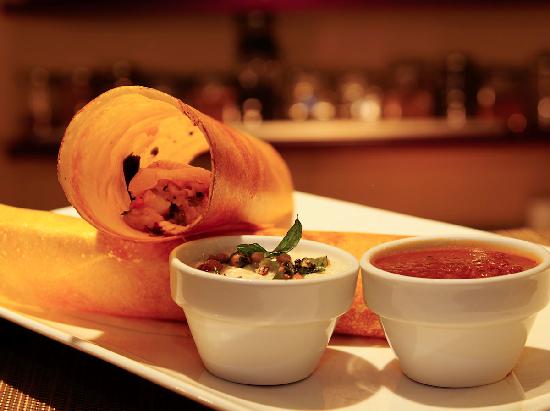
You cannot dine at Nilgiri’s without having a masala dosa ($18). If Ajoy had a “signature dish” – this would be it. The dosa was light and crisp, containing a wonderfully spiced potato masala with the predominance of cumin and mustard seed coming through. Served with fresh coconut chutney and a sambar (lentil soup) – this is South Indian comfort food at its best.

The other entrée we shared was Golgappa ($16) which is a popular Indian street snack. These are hollow, ball-like fried crisp puri which are usually about golf-ball size so you can place them straight in your mouth. Nilgiri’s were a lot larger – probably deliberately so – as there was a lot of spiced chickpeas to be placed in these wonderful crisp balls. The spiced chickpeas were moist and “al-dente” and when spooned into the puri and then eaten, the whole combination was an interesting mouth fill of crunchy spiciness.

Murg makhani ($27) is technically what us westerners would call butter chicken – a dish that typically is the first Indian cuisine experience of many Australians. Real butter chicken, that is, murg makhani, is not what you find in a high-turnover Indian food outlet. Murg makhani when done the “real” way is a flavoursome, delightful and soul-satisfying dish. Ajoy marinates diced chicken and then bakes it in the tandoor with a mixture of puree tomatoes, honey and dried fenugreek. Cooking the chicken in its own juices and the marinade produces tender and succulent pieces of meat which in turn makes its own rich and flavoursome sauce which is smooth and creamy with a wonderful balance of acidity from the tomatoes and creaminess of the chicken marinade. Slightly smoky from being left in the tandoor it is no doubt a sensory and comforting dish. One of the best.

We also chose kadhai machchi ($29), a fillet of fish which had been crusted with a masala (with the predominate flavours of coriander, pepper and cumin and ginger coming through), which was then pan-fried and topped with a mustard-flavoured sauce. The fish was firm and moist, floating in a creamy, crushed mustard seed sauce which was rich and mild and extremely flavoursome.

As accompaniments we had rice ($3) and shared a lasooni naan ($4.50) which is garlic-infused flat bread backed in the tandoor.

It’s easy to over eat when sharing at an Indian restaurant but room must be left for one of the kulfi’s – which is a style of frozen milky dessert (much like ice-cream) but flavoured with typical Indian spice infusions – in this case we had the pista kulfi a pistachio and cardamom infused kulfi as well as the date and honey. The pista kulfi is a good introduction and will give you an appreciation to these styles of desserts as it combines the typical sweet/spicy flavours of cardamom with the milky sweetness from the condensed milk which is used as its make-up. The date and honey is, of course a lot sweeter, and is somewhat reminiscent of a frozen sticky date pudding. Both are good but I have a slight tendency towards the date and honey.

Nilgiri’s is as authentic as ‘real’ Indian cooking can get and reflects the experience, care, love and precision that comes from a top chef. Rest assured you are in safe hands with the guru of Indian cooking in Australia -Ajoy Joshi.

The verdict: This is real Indian cooking and where to come to sample good value and excellent regional dishes from the sub continent that are not run-of-the-mill. There is something for every one, from banquets to al la carte or quick lunches or weekend brunches. With a monthly changing menu highlighting regional specialities that you would not normally see in Australia – Nilgiri’s is a connoisseurs’ restaurant for fans of India’s marvellous and eclectic cuisine.

What: Nilgiri’s, 81 – 83 Christie St, St Leonards NSW Australia, Phone (02) 9966 0636. www.nilgiris.com.au

Ate there: February 2013.

Note: You can read and subscribe to Ajoy’s blog at: http://thoughtsfromajoy.wordpress.com

Posted in Indian, New South Wales, Sydney | Tagged , , , , , , | Leave a comment

The New Nadi Farmers Club and Raju’s

ABOUT a third of Fiji’s population is made up of Indo-Fijians who are mostly descended from Indian indentured labourers brought to the islands by British colonial rulers to work on Fiji’s sugar cane plantations. As such, Fiji’s cuisine is also influenced by Indian cuisine. On my recent visit to Fiji I was wanting to try examples of Indo-Fijian food and I have two spots that serve some good Indian food at locals’ prices.

Farmers - BureThe New Nadi Farmers Club was recommended by a taxi driver (and other drivers and locals concurred), as a good place in Nadi Town to get a drink and a meal. The club is run by Aussie lass Tracey and her Fijian husband Tom. Tracey also owns the Bondi Beach Bag Co., and has her Fijian boutique in the club.

To use an Australian analogy, the Farmers Club is like an RSL – you can get a meal, a drink and entertainment.

You enter the club via the main bar area which has tables and bar stools and large TVs with satellite stations. There is the Bondi Beach Bag Co. boutique as well as an indoor dining area but the main attraction is the sparse outside beer garden that overlooks the river where you can sit under the veranda or on one of the stools under a thatched bure. There is also a small stage where live music is played.

Farmers - bandThe clientele is mainly locals with a mix of tourists and ex-pats. Be aware that the locals love to dance and you may be grabbed and flung out to the centre stage. They also love to have a few drinks, so it is wise to stay at the end from the locals (especially in the late afternoon after work), as things can get loud as people get” excited”. We didn’t see any trouble (and staff will keep a look out).

We were told that the Farmers had a very good fire dance and cultural show staring an 11-year-old boy who is Fiji’s youngest fire dancer (we saw him on his skate board flinging and twirling his sticks around as a warm up). Visitors say it was the best one on the island (from reading reviews of it), and it is free.

The Baroness and I went to the club on two occasions to have a drink and dinner. The first occasion was to prepare ourselves before we headed off to meet my Fijian “brother from another mother” at Nadi’s latest locals’ disco – The White House (an interesting place to say the least as it includes strategically-placed poles which you can dance around under the watchful eye of bouncers that are bigger than King Kong). If you go there just be alert.

You can get drinks from the Farmers Club main bar but waitresses roam and will keep an eye out on your drink if it gets low and will take your order. Beers include Fiji Bitter or the better Fiji Gold (FJD$5 for a stubbie, FJD$54 for a 3-litre tower or FJD$550 for a keg!); Fiji’s very own ready-mix alcho-pops called ‘Tribe’ (F$5.50); wine and bubbles by the bottle (from FJD$35), and passable cocktails (a cosmopolitan will set you back FJD$18).

The menu has western favourites (chicken schnitzel, salads and club sandwiches and a decent kids’ menu) but it was the curries and ‘chasers’ that appealled to us. The chasers are little appetisers or nibbles to have with a drink.

All curries come with dal, a vege curry, chutney and either rice or roti, so it’s like having a thali. You can add additional items such as extra roti (FJD$1 per price) or another curry (from FJD$9.90).

Farmers - spicy fishOn our first visit we started with two chasers: calamari rings (FJD$9.90) and spicy fish (FJD$9.90). When the calamari came out is was thermo-nuclear hot! Once it had time to breath it was a classic battered ring enhanced by a tangy lemon dipping sauce on the side (instead of the usual lemon wedge). Ideal for the accompanying Fiji Gold. Baronesss loved the sauce. I thought the spicy fish was the pick: similar to fish tikka, it was cubes of firm pearl-white fish that had been marinated in a dry masala (blended Indian spices) and then baked. A chili dipping sauce accompanied it. Both chasers beat the classic potato wedges at any RSL.

Farmers Club - CurryWe followed the chasers with a prawn curry to share (FJD$16.90) with four pieces of extra roti on the side (FJD$4). The curry was excellent. A small handful of good-sized prawns with tails still on were immersed in a peppery curry sauce. The added vegetable dishes: a potato and pea curry and a watery yellow dal, were also good. A tamarind chutney was on the side.

On our second visit we went for the calamari chaser followed by the boneless chicken curry to share (FJD$14.90). The chicken curry was cubed thigh fillets in a mild, yet flavoursome sauce and was accompanied by the two same vegetable dishes as on the previous visit.

Both the prawn and chicken curries were good and were made using fresh ground masala – well worth the price and the trip to the club.

Service is excellent (local staff enjoy chatting to tourists), and Tracey and Tom ensure that visitors feel that their local club is also your club away from home. Kids are most certainly welcome.

Food came out fairly promptly (we were the only ones eating at that time, though) and from reports the club can get busy in the evenings (especially for the show).

Rajus - InsideRaju’s Indian Fast Food Curry Restaurant was discovered by chance while doing a quick grocery shop in Nadi Town. It is a small restaurant packed full of local Fijians and Fijian Indians alike and is located off Queens Road down a small side street called Park Street and is almost opposite a discount “two dollar” shop.

It’s a basic “diner”. There are booths on one side of the wall and large tables in the centre. Towards the back wall are the staff behind the bain-marie filled with curries. I ordered from spec – a lamb curry, dal and roti which all came to FJD$8. Service was friendly with the waitress telling me what was on for the day and bringing it all over to me with a carafe of cold water.

20130123-145339.jpgThe lamb curry consisted of cubes of lamb on the bone in a dark rich sauce. Not overpowering or spicy but certainly flavoursome. The yellow dal was of a watery soup consistency and seemed spiced predominately with cumin. I must admit I prefer the thicker dal (like a dal makhani or dhal palak). I have read that Fijians tend to use yellow split peas instead of chickpeas or lentils, so it may explain the style of dal that was served. It was, though, a good accompaniment to the lamb and meshed well with the robust flavours of that curry.

The roti consisted of four folded sheets and was moist and tender. In hindsight I should have ordered a serving of rice in order to soak up the dal as roti just doesn’t do it (I had to do the old slurp from the bowl trick).

Raju’s is a local’s place and it was nice to be the only non-local dining there among the lunch time workers. It is well worth a look if you want something original and authentically local dining experience. Don’t be intimidated – staff are very helpful and will make sure that you will get something delicious.

The verdict: Two nice and cheap eating spots: The New Nadi Farmers Club is a good place to sit outside and enjoy a beer or cocktail in the beer garden as well as a snack or cheap meal after pounding the main drag of Nadi looking at tacky souvenirs. Raju’s is ideal for a “curry in a hurry”, has local flavour and atmosphere, and is well worth a look away from the places that the touts will try and lure you into.

What: New Nadi Farmers’ Club, Ashram Road, Nadi, Viti Levu, Fiji; Raju’s Indian Fast Food Curry Restaurant, Park Street, Nadi, Viti Levu, Fiji.

Ate there: 3 and 10 January (The New Nadi Farmers’ Club); 8 January (Raju’s).

Note: FJD$1 = A$0.53 at time of writing. Also Vonu is the pick of beers in Fiji. If you find it, try it.

Posted in Casual dining, Fiji, Indian | Tagged , , , , , , | Leave a comment

Nadina Authentic Fijian Restaurant

Nadina - AggieWHAT the f**k did Aggie just do? Aggie, the outgoing and charming (and very broad), Fijian hostess at Nadina Authentic Fijian Restaurant had just given the Baroness of Balmain an almighty whack square on her forehead while walking past our table. It was so loud it turned the heads of other diners.

The Baroness and I had just finished the best meal we had eaten during our two-week stay in Fiji and now, on our last night on the island, one of us just had to get assaulted by a local.

Baroness is not one to shy away from anything – she stands her ground and will thump back (though anyone may want to think twice before taking Aggie on). I was ready for a showdown. I was also contemplating how much money was possibly needed to raise bail in case the Baroness struck harder and Nadi’s finest were called in.

So, what sparked this sudden spate of madness by Aggie after having just served a particularly decent mojito to us to finish a wonderful meal? A mere mosquito. It seemed Aggie was concerned more about Baroness being bitten by the large mozzie that had just landed on her (and therefore possibly contracting some tropical sickness), than worrying about any resulting concussion or brain damage that may have followed from a swift blow to her forehead. I suppose it was authentic Fijian hospitality at the extreme.

Nadina-OutsideNadina Authentic Fijian Restaurant overlooks the ritzy waterways of Port Denerau just a few kilometers west of Nadi on Fiji’s main island – Viti Levu. The Port is home to some fairly expensive real estate and pleasure craft and also has snazzy shopping boutiques and other fine restaurants as well as Fiji’s Hard Rock Cafe.

The restaurant is at the end of the Port Denerau pier and has a small indoor seating area as well as outside tables. As this is the South Pacific, it’s better to be outdoors on one of the many wooden tables that extend from the main restaurant to the edge of the water (where you can hear the Fijian band play what seems the same serenades you hear on every day boat trip in Fiji) while watching the sun set over the water and against the backdrop of the boats. In fact, I don’t even recall seeing people dining inside. Kids are well entertained by the band or by the waiting staff.

I had the preconception that Fijian cuisine was all about basic pig, fish and root vegetable dishes (read: boring). Well, I was wrong – chicken is also a staple and the dishes we had were far from boring.

The menu features what seems to be Fijian specialties, Indian influences, and some “tourist and child-friendly” items. For example there are chicken winglets marinated in honey and soy and cooked in chilli sauce (FJD$12); pork spare ribs with barbecue sauce (FJD$16.50); soups (from FJD$9); fish dishes like Ika Vakalolo (FJD$30) which is a pan-fried walu steak simmered in a lolo, tomato and onion sauce; prawns in coconut curry (FJD$35); fish and chips (FJD$25) and beef curry (FJD$30).

There are also daily specials written on a backboard outside – tonight it featured lamb curry (FJD$30), whole coral trout as well as another coral trout dish (FJD$45), and local lobster (FJD$53).

The wine list is adequate with a cross-section of styles from Australia and New Zealand. We had a bottle of the Villa Maria Pinot Gris (FJD$55).

Nadina - kokodaFor entree, I had kokoda (FJD$16) (pn: kokonda) which is a Fijian specialty. It’s like ceviche – raw fish that is basically “cooked” using the acid from limes. It was served in a boat-shaped bowl and consisted of pieces of chunky fish immersed in what is known as miti – a sort of cold “soup” of coconut milk with diced capsicum, mild chili and onions. To the side was a wedge of lime, peppers and a small shredded salad. It was truly a very good dish. The fish was “cooked” with limes which also added flavour and seasoning, and the tangy and creamy coconut broth was an excellent accompaniment. An ideal fresh and light dish for such a warm, tropical evening. What was exciting about the dish was the freshness of the ingredients. Having spent two weeks in Fiji we had not come across such fresh produce and as a result most other meals had seemed mediocre. Our waiter told us that the restaurant grows all its own vegetables so they don’t have to rely on any suppliers. Nadina also extracts its own coconut cream and milk (so no tinned ingredients are used).

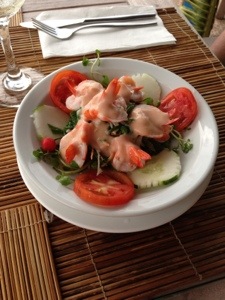
Nadina - Prawn cocktailBaroness had the Viti-Levu style prawn cocktail with a “bush fern salad” (FJD$18). The dish is named after Fiji’s main island. Even though there is no shame in having a prawn cocktail (versions of it have made a comeback in many fine Australian restaurants), we debated as to whether it would come out in a typical ’70s champagne saucer. Alas, our hope for a true retro experience was dashed when a bowl arrived. The dish featured large prawns topped with a “lolo cocktail sauce” and was accompanied by slices of cucumber, tomato and small bush fern leaves. Again, freshness of the produce was incredible. Baroness commented that after seeing the ripe, crimson tomatoes she suddenly released that she was longing for salad – something we hadn’t seen during the whole stay. The prawn cocktail didn’t disappoint. It was true to form with the lolo dressing slightly spicy and tangy and packed with tomato and coconut cream flavours. Again, an ideal dish for the tropics.

For the main I was tempted to order what was highlighted as Navinda’s signature dish – kovu – a Fijian cooking style where you could have fish, prawn, chicken, pork or vegetables – marinated in ginger, turmeric and onion – which is then wrapped in banana leaves and steamed (FJD$35 to FJD$40). It was going to take 40 minutes to cook and the waiter was persuading me towards the kete-ni-vuaka (pork belly), so I decided to go with his advice.

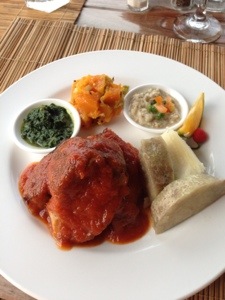
Nadina - pork bellyThe pork belly (FJD$33) was served with rou rou (steamed taro leaves that are cooked in coconut cream); a small pumpkin dish infused with cumin and a slightly spicy eggplant dish. You could also chose between dalo (taro root) or mashed potato or sweet potato. I went with dalo. Again it was emphasised by our waiter that all the produce was grown by the restaurant. The pork belly was excellent – moist, smoky and succulent. It was drenched in a rich and flavorsome tomato concasse.

The vegetable sides were fresh and delicious. The rou rou was like steamed spinach sweetened with coconut cream. The pumpkin and eggplant were where the Indian Fijian influences were highlighted – fresh and wonderfully seasoned – and not unlike tiny vegetable curries. The only downside was the dalo – I found it lacked any flavour but as it is a Fijian staple I had to give it a go. Mashed sweet potato probably would have been a better accompaniment to the smoked pork belly.

Baroness finds it hard to resist lobster. Nadina had a special – local 500g Yasawa Reef lobster with a bush lemon and garlic sauce (FJD$53). It was a no-brainer. What she got was superb (especially for the price). Again the dish was served with the same vegetable sides I had but Baroness wisely chose mashed potato instead of dalo.

20130113-160407.jpgI struggled in coaxing the Baroness to give me a flake of flesh. The whole lobster was halved with the meat still in its body and drizzled with the bush lemon and garlic butter-based sauce. It was an excellent serving for the price and was tender and sweet with the accompanying sauce light and citrisy without being too overpowered by garlic. It certainly left Baroness very contempt and happy.

There is not much in the choice of desserts. I had the baked banana with toffee syrup and ice cream (FJD$9.50) and for the Baroness: banana pancakes with toffee syrup and ice cream (FJD$12.50). We could have had steamed grated tavioka (cassava), instead of banana but having tried a not-up-to-scratch dish at our resort, I never want to have cassava again.

We topped off the evening with a couple of very good mojitos (FJD$16.50) followed by a free slap on the forehead – an act of endearment, Fijian style.

The verdict: Be amazed by the freshness of the produce and the size of the meals. Don’t expect typical Fijian service – the waiting staff are actually quick; efficient and attentive, and meals come out well prepared and timely. A wonderful pier location overlooking the harbour where you can listen to a local band while watching the sun set. Kids are certainly welcome. Wished we discovered it earlier. Bring mozzie repellent if you don’t want to be slapped!

What: Nadina Authentic Fijian Restaurant, Port Denarau Marina, Shop R1 & R2, Denarau Island, Viti Levu, Fiji. Phone: +679 675 0290. Email: nadina@conect.com.fj

Ate there: 11 January 2013.

Note: FJD$1 = A$0.53 or US$56 at time of writing.

Posted in Fiji, Fijian | Tagged , , , , | 1 Comment