Cho Dumpling King

I THINK it would be easier to get a ticket to a Jay Chou concert at Taipei Arena than a seat at Cho Dumpling King (CDK).

CDK is one of the more popular little hole-in-the-wall places in the Burlington Centre in Sydney’s extended “Chinatown” Haymarket precinct. It’s packed full of mostly homesick Taiwanese (TW) students longing for some TW street food or some TW comfort food as mum is a long way from their university student halls.

Despite CDK’s name there are no dumplings (and you will be told that if you ever get a seat there). An idea of what you’ll get is plastered all over the outside of CDK’s walls and windows. Big and colourful pictures of its dishes jump out at you detailing the specials and set menus. It also attracts customers using a display of small Taiwanese snacks (xiao chi 小吃) that sit proudly behind a large window – deep-fried white bait; cold pork belly with cucumber; pig’s ears; caramelised eggplant and green beans with ground pork – such small snacks are typical in Taiwan, especially in its old capital Tainan. At $3.50 they’re an inexpensive option to try a handful of xiao chi and get a pretty good idea of Tainan-style cuisine.

During my first visit to CDK I got the impression that staff gravitated to taking take-away orders or looking for seats inside for those homesick TW expats rather than newbies – maybe because they haven’t got the time to explain what TW snack food is to window shoppers and as there is always a constant mob of people lining up and vying to be seen and heard? So, if you want to be taken seriously and get noticed do what I do (and it works) – just ask the question: “lu rou fan“? Lu rou fan (滷肉飯) is stewed minced pork belly served with rice and it is a staple TW comfort food (and is served with almost everything at CDK). It got the staff interested in handing out a menu and taking my order for take-away on my first visit – a set meal of lu rou fan and TW fried chicken pieces ($10) which I then took to eat at a neighbouring food court.

TW fried chicken is actually a common snack food in Taiwan. It came in one of those usual plastic takeaway containers but thankfully the staff had the sense to puncture the top so that the steam could escape, therefore ensuring that the chicken’s fried batter remained crunchy and not subject to sweating in a small plastic sauna. The bite-sized morsels of chicken were good – soooo good! TW fried chicken batter is light (potato starch is usually used which really crisps up when deep-fried), and it is seasoned with salt and usually five spices. The meat is still on the bone (so watch those teeth), and was tender and juicy and coated with a not too-overpowering batter.

It would be extremely dangerous for CDK to stuff up lu rou fan considering it’s the national comfort food staple of Taiwan. CDK didn’t. The stewed pork belly was well seasoned with the usual soy sauce, Chinese wine and sugar combination (which caramelises the minced pork belly to give it a typical sweet and dry robustness), and the addition of garlic, mushrooms, dried shrimp and five spice give it that certain body and ‘sauciness’ that is needed. The only complaint was that the rice was a bit overcooked. Comforting? Yes!

So far so good. I next visited CDK six months later.

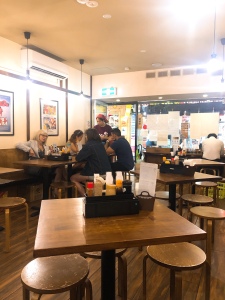
On the latest visit I finally got a seat at the CDK gig but I was there at 11am and within five minutes I was joined by a stranger willing to share my table for two (my table was actually the last available). Inside, CDK is a small, elbow-room-only place that only seats 20 with a small serving bar to the side and I don’t now how the five waiting staff negotiate around the tables and diners without major mishap.

As on the last visit I was told: “no dumplings” and again I had to prove my TW credentials inquiring in pidgin whether CDK had a couple of typical TW snacks. Then came the wry smile, a pot of tea and the menu.

The menu seems extensive but it offers a lot of different combinations, deals and set menus which is quite refreshing as it allows you to savour a combination of different styles of dishes. You can grab a TW set meal which is a bowl of lu rou fan plus a choice of some 12 other snacks (which reflects the happy hour meals cited below), for $10 or $11 for an upsized version. From 2pm to 5pm CDK has 10 meals for $7 each (such as cold noodles; deep-fried tofu, chicken, squid balls or fish cake; and lu rou fan). Then there are the $10 value meals where for an extra $1 you can also get a bowl of soup or a bubble tea. These meals are either bento box sets or larger versions from CDK’s main specials (like fried fish; braised beef; stewed pork and soups or noodles).

I scoured the room and saw diners mostly ordering the set meal bento boxes or lu rou fan and TW chicken along with a xiao chi. I decided to order one of the set meal lunch boxes ($10) and for an extra $1 I could upgrade to a bubble tea or the soup of the day – in this case a large bowl of hot and sour soup. I decided on the soup.

Along with the fried fish, the bento box’s compartment had an old favourite – green beans with ground pork (乾扁四季豆). There also were some pickles; corn; rice and orange segments.

I must admit I thought the chilli fish was bland. The top fillets were thick and tender with a lovely crunchy, salty seasoned batter but the sauce was ordinary and really didn’t add anything to the fish and in some ways toned down the salty batter (and made the bottom fillets soggy and stodgy). It would have been nice just to have the fillets without the sauce or at least have the sauce to the side. The green beans with pork was typical – crunchy, stir-fried beans with sweetened caramelised pork mince (delightful)! The corn was, well just sweet corn kernels and the pickle added a needed acidic burst after munching on all that protein.

The hot and sour soup for the extra buck was huge. It was thick and full of sliced shiitake mushrooms, tofu and sliced bamboo shoots. At first I thought it lacked some flavour but I then realised that this was a very good subtle version with the sour and spicy ingredients blending harmoniously together so not to be overpowering in one particular direction. It was filling and combined with the bento box maybe too much for my shrinking tummy. The bubble tea option may have been the way to go.

As soon as I had finished out came the bill and the table was cleared. There’s no mucking around – CDK isn’t the type of place where you can linger as staff want you to eat and be gone so the next in the queue can squeeze in.

CDK may not be the best TW gig in town but it’s popular because it has an interesting variety of xiao chi for those homesick TW expats that you don’t really find in Sydney and good-value set meals that come out fast and furiously.

The verdict: You may have to prove your Taiwanese credentials to the staff but Cho Dumpling King will give you an easy and cheap (but no-thrills) insight into the world of Taiwanese snack food.

What: Cho Dumpling King, TG6/8 Quay Street, Haymarket NSW 2000 (02) 9281 2760. Open Monday to Sunday from 11am to 8pm.

Ate there: 4 November 2011 and 5 May 2012.

Posted in New South Wales, Street Food, Sydney, Taiwanese | Tagged | 2 Comments

Janani

THE Deity had never been to Homebush but knew that it was somewhere near a complex of temples and shrines devoted to the sporting gods that came from across the planet to Sydney in the year 2000. Despite the lack of familiarity with this south-western Sydney suburb The Deity did expect some decent offerings as Homebush is home to a proportion of Sydney’s Indian and Sri Lankan communities.

Janani is housed at the bottom of some brick apartments on Burlington Road and it offers a Sri Lankan inspired menu with South Indian nuances. There are two areas – a small take-away room with a “pie warmer’ full of roti “rolls” stuffed with spiced potato; lamb or fish, as well as an assortment of snacks such as vada, samosa, pakora, and onion bhajji. Take-away orders from Jabai’s menu can also be made.

Then there’s a large indoor restaurant (with function room). The dining area isn’t striking unless glaring and colourful Bollywood MVs are playing on televisions. A bevy of fridges are stacked with Sri Lankan and Indian soft drinks (such as ‘Thums Up” cola and “Necto”), milk, water and other liquids.

Outside, tables line the stark veranda with Sri Lankan tourism posters fixed on the exposed brick support pillars and, yes, a TV (I’ve been to Janani before – a few summer’s ago – when the TVs are usually tuned into a cricket game. Thankfully cricket season was over or The Deity would have been fixated on it).

You could be forgiven into thinking you were in some Colombo street cafe – everything comes out on (or in) stainless steel: cutlery, drinking tumblers, plates, dishes and bowls. Service is casual.

The menu is extensive. There are varieties of naan and paratha (from $2); chapoori; chapatti; channa bhatura ($10); different varieties and styles of curry (seafood, lamb, goat and chicken), over 20 types of dosa (from $6.50); scotch eggs ($3); tandoori chicken and chicken tikka; biriyani, a choice of different thali; and street delights like samosa, vadai, idli, bhajji and hoppers.

I haven’t had a hopper since a visit to Sri Lanka in the late 1990s. Hoppers (or appam) are a staple breakfast dish for Sri Lankans. A hopper is a bowl-shaped thin pancake made from fermented rice flour. At Jannai you can have it plain, with a fried egg (an egg hopper), a milk hopper (which has a spoonful of coconut cream in the centre) or a jaggery hopper which is cooked with palm sugar. Janani also has the marvellous string hoppers (noolputtu) –which are made from rice flour dough which is pushed through a string hopper press into a hopper mould and then gently steamed and used to mop up curry (these weren’t tried on the visit).

Tamil literature has mentioned Hindu deities being ritually offered appam for centuries. Based on this, I thought it essential to offer The Deity an egg hopper ($3.50) which came with a small dish of pol sambol (ground chilli, maldive fish and coconut). This was a perfectly cooked thin and light hopper with a nicely fried egg. The pancake had that slightly acidic and fermented sourness to it which then combined with the sweet and savoury flavours of the sambol and fried egg. I found it quite traditional however The Deity found the combination of sweet, sour and savoury not too divine.

The Deity demanded a dosa – those wafer thin crepes made from fermented rice and lentil flour and making them properly is an art. The masala dosa ($8.50) was incredible – it seemed almost a metre long. This thin and crunchy crepe was neatly filled with a slightly spicy potato masala and served with sambar, raita (mint, carrot and coconut), and chutney. It’s always pleasing (and reassuring) to find a piece of cassia bark in a sambar (I know it’s made properly and with love)!

The Deity thought it was the best dosa ever (and The Diety is an expert on dosa). I had to agree – it wasn’t oily, there wasn’t too much potato masala in it to be overwhelming, and the five accompaniments were perfect matches. It was a star.

We just had to have a thali and the pick was the prawn thali ($14.50). It came on a stainless steel thali plate with rice, a poppadom, and six accompaniments (ranging from sambar, pickles, chutney and small serves of curry). The four prawns were in a rich, deeply-flavoured peppery curry sauce with hints of curry leaves, garlic, onion and coconut. The dish, despite there begin only four prawns it, was a more than adequate when taking into account all the accompaniments. The Deity and I had to fight over the remaining curry sauce – it was, quite simply, yummy.

Even though no garlands or incense awaited The Deity and I during the pilgrimage to Homebush (just the wafting scents of roasted cumin, mustard and curry leaves), Janani was able to offer extremely satisfying and well-priced Sri Lankan and southern Indian classics.

The verdict: Ignore the starkness of the place and just choose from an incredible list of flavorsome Sri-Lankan and South Indian foods. Simple, basic surroundings but the food is divine (and you can even take some Sri Lankan-inspired street morsels home with you).

What: Janani, 32 Burlington Road, Homebush NSW Australia (02) 9763 2306. Open weekdays from 10.30 am to 10pm and weekends from 8.30am to 10.30pm.

Ate there: 18 March 2012.

Tip: Selva’s Spices is 50m down Burligton Road from Janani and there you will find all the Sri Lankan and sub-continant essentials including a fridge full or Sri Lankan soft drinks such as the famous bright crimson and cherry-flavoured “Necto” with the marketing tag that reads: “Necto explodes with giggles and great fun” . Warning: keep out of reach of children (and some grown ups). It’s crimson, fizzy and sweet. Say no more.


View Larger Map
Posted in Indian, New South Wales, Sri Lankan, Street Food, Sydney | Tagged , , , , | Leave a comment

Fiji Market

FIJI Market has fascinated me for years. I discovered it some 15 years ago when I was finding my feet in the Emerald City as I had to walk past it daily from St Peters station to a mate’s place until I found some digs elsewhere in Newtown.

The store fascinated me for two reasons: there was no such thing as an “islander” shop in Adelaide back then (despite SA’s great Premier Don Dunstan being a Fijian Indian); and there was a gorgeous parrot that seemed to command the joint and greeted regulars as they entered.

Fiji Market is one of the stalwarts on the southern (and more interesting), end of King Street having been there since 1981. Run by Don Prasad it is an exotic Aladdin’s Cave of everything that you would need for a sub-continent or islander feast (or Bollywood party). It’s an enticing shop and half the fun is ducking and weaving in the narrow aisles amongst colourful saris, fabrics and garlands; and being mesmerised by glittery bangles and the endless array of ground and whole spices.

Despite being slightly claustrophobic, Fiji Market is colourful, smells terrific (a blend of robust spice and sweet incense tones), and is just one of those shops you want to spend an hour or so exploring every shelf and aisle (I’ve been there a countless number of times and I still discover things).

The first two aisles are dominated by spices – packets of pink peppercorns; nigella seeds; cardamom pods; pepper; star anise; cumin; fennel; ground and whole chilli; cinnamon and cassia quills, panch poran; etc, etc, etc.

The adjoining aisle is packed full of ground curry blends and maslas (Don’s own and the good-quality local, Indian and Pakistan brands); dosai, idli and vada mixes; jars and jars of sticky chutneys (and even guava paste). Don also has his own range of curry mixes (labelled Natraj), which includes a popular special curry blend that I have used and recommend (comes both mild and hot), as well as a chai .

The last aisle features Indian read-to-eat packet meals (mainly vegetarian – like aloo mutter and dal), bags of lentils and cooking utensils. You could spend a good half an hour just checking out the utensils. There are tiffin carriers; stainless steel tahli; pots and pans; coconut scrappers and chapatti rollers; cooking vessels and gleaming copper kadi.

The back wall is devoted to Mexican goods (which I have noticed growing in variety in the past couple of years). Here you will find canned and dried chilli (jalapeño, chipotle, and ancho); hot sauces; salsa; spicy Bloody Mary mixes; beans; mole sauces, hominy, flour and even Mexican chocolate.

Near the checkout area hanging from the walls and ceilings and on racks are colourful sari and fabrics; bindies, galands, beads and bracelets (and even Fijian shirts!)

Don also has a separate room out back which is almost like a rice temple with sacks and sacks of varieties of rice from around the world (it smells clean and pure and rice devotees won’t want to leave it for the real world).

Out front (where the parrot used to rule), are fresh fruits and vegetables; cooking books (the decent curry ones); fridges and freezes (with fresh herbs, fish, drinks, pandan and betel leaves); and I have occasionally spotted curry trees in pots.

Fiji Market also has a selection of sub-continent beauty products like sandalwood soaps; cleansers, henna and henna stencils, and even hair oil and, of course, Bollywood movies.

Don and his staff (who always seem flat out packing and sorting), are happy to help (they know where all their treasures are hidden), if you get overwhelmed exploring.

Just how good is Fiji Market? I kicked myself for not going there first when I was searching for a particular specialty item. I drove almost all over western Sydney to find a tiffin carrier (as I moonlight as a dabbawala for a deity), and guess what? Fiji Market had them (and in different sizes).

What: Fiji Market, 591 King Street, Newtown, NSW Australia. Phone (02) 9517 2054.

Best buys: Curry trees, the spices, Mexican foods, rice and the cooking utensils (especially the tiffin carrier).


View Larger Map
Posted in Grocery, Indian, New South Wales | Tagged , , , , | 2 Comments

Harry’s Singapore Chilli Crab

THE barman at the Triple Ace Bar was particularly unimpressed with the Real Evil Genius (REG) ordering a middy of Resches shandy. It was Happy Hour at the Triple Ace where schooners of Resches were only $3.50 but REG wanted a smaller and diluted (he would argue “enhanced”) beer with lemonade (aka shandy), which, as the barman explained to REG, would cost him more as it wasn’t covered by the bar’s Happy Hour policy.

A Mexican standoff arose. The barman couldn’t believe a bloke didn’t want more beer for less (and would order a beer with lemonade in it). REG couldn’t believe that the barman didn’t understand that all he wanted was a small shandy (as he liked lemonade in his beer). A mediation ensued (REG is a skilled mediator), and even though money and shandy were traded both Reg and the barman were left a bit dismayed. I was just left recovering from an anxiety attack as I was concerned for REG’s physical well-being as the Triple Ace is a favourite watering hole for really big blokes that use different mediation techniques than REG and who were watching the exchange with great interest.

Harry’s Chilli Crab is a Sydney institution and is on the top floor of the aforementioned Triple Ace Bar – just a few steps up from a side entrance at Campbell Street in Sydney’s Surry Hills. It was started some 30 years ago by Harry Lau and you can’t miss it – there is a huge illuminated sign on the hotel of Harry with his trademark smile proudly holding a giant mud crab.

Climbing the few steps up to Harry’s you are greeted by crates full of huge live Queensland mud crabs waiting to be grabbed and served. It’s a bit surreal meeting your dinner at the door but that moment of sadistic guilt passes fairly quickly when the ice-cold Tiger and Tsing Tao beers arrive with a few more stuffed into a bucket full of ice (not only convenient but also a good sales technique). The restaurant space isn’t anything special – it’s a bit small and slightly poky and outdated (with that 1970s Chinese restaurant kind of charm), but Harry’s devotees don’t come for the décor – they come for the giant crustaceans mingling outside awaiting their unfortunate fate.

At $85 a kilo it isn’t going to be a cheap meal, especially considering that we were recommended a 2kg mud crab. There are 11 featured cooking styles for these massive crabs. Along with the famous chilli crab you can have pepper and salt; ginger and shallots; and black pepper (just to name a few that caught my eye). We went for the traditional Singapore chilli crab and were asked how spicy we wanted it (on a scale of 1 to 10 with kids apparently a 4). We went for ’7′ – although REG and I both like heat we needed to be a bit wary as we had never really encountered the scale before and didn’t want to overpower the crab meat. It proved to be a good decision (although I could have gone up to an ‘8’ with hindsight).

The staff also recommended to have a plate of roti for dipping into the chilli sauce and some greens – in this case it was the garlic kangkong ($15).

Crabs are not the only items on the menu (but the restaurant is famous for them). You can also order from a range of Straits Chinese and Malaysian-style foods such as fresh barramundi fillet and snow peas ($26.50); scallops (from $30); lobsters at market price and a variety of prawn, duck, pork, vegetable and noodle and rice dishes. Banquets are also available with notice.

As the huge gleaming red crab came out on a platter cut up and swimming in a thick and egg-based and rust-colored chili sauce so did the manager with two huge plastic aprons which he wrapped and fastened around me and REG. Plastic aprons are a good thing for the HBV as I have the tendency to sometimes (and embarrassingly) wear food, spill the odd drink or, as one dining companion recently witnessed, brush crushed ice onto the floor of a trendy Sydney cocktail bar after it escaped from an ice bucket. I’m not a grub, it’s just that my arms wave about when I get excited.

Eating crab isn’t for the faint-hearted – you have to get stuck into it and it is going to get messy. I kept my eye on REG to get tips as he is a ‘crabophile’. He attacked the crab the way he tackled that barman – persistently, politely and with precision – not giving in to it and ensuring the red exoskeleton was hollow when he finished with a segment. He also ensured the HBV was getting his fair share.

The crab is quite good. Cooked very well with the right amount of time and it had surprisingly large amounts of melt-in-the-mouth sweet flesh throughout its shell (I’m always skeptical when it comes to large crustaceans). The sauce had the right amount of heat, was thick, robust and flavorsome with hints of onion, ginger, garlic and chilli and not overpowering. The firm roti was used to scoop this wonderful sauce in between us liking our fingers.

The steamed garlic kankong was firm and tossed in crushed garlic. A nice complement to the crab.

Harry’s motto is: “Nobody leaves my door unhappy”. We didn’t leave unhappy, just an empty beer bucket, a couple of kilos heavier and our wallets a bit lighter (it can be pricey). And, best of all, I didn’t have a speck of food or sauce on me.

Who needs to go to Singapore for good chilli crab?

The verdict: Dining at Harry’s may not be like sitting under a blanket of humidity overlooking the sea at Singapore’s East Coast Seafood Centre while ripping into a true Singapore Chilli Crab but it’s no accident Harry is still in the crab game after 30 years – he recreates a good authentic Singapore chilli crab style using carefully selected Queensland mud crabs which are lip-smacking great.

HBV tip: The Triple Ace Bar is a pleasant, old-school Sydney pub without the crap (and it doesn’t take any either), with cheap ice-cold beer. Just don’t order a shandy.

What: Harry’s Singapore Chilli Crab, 198 Elizabeth Street (enter via Campbell Street), Sydney NSW Australia. Phone: 9281 5565. Open for lunch from Tuesday to Sunday 11:30am to 3pm and dinner seven nights from 5.30pm to late.

Ate there: 5 January 2012.


View Larger Map
Posted in Chinese, Hawker food, Malaysian, New South Wales, Street Food, Sydney | Tagged , | 2 Comments

La Vucciria

AFTER opening the bright and lacquered red door at La Vucciria I must admit I was a little bit taken a back with the decor of this Sicilian trattoria – I thought it a bit too dark for my ageing eyes. Tea lights and a couple of slated wooden (but beautiful) ceiling lights try to illuminate its black walls and dark wooden floors where dark blackwood chairs and tables stand. To one side is a grey marble bar lined with wooden stools with the rear wall stocked with what seems to be every liquor required. Large black-and-white photographs of Palermo’s famous La Vucciria market (which the restaurant is named and inspired by), adorn the opposite wall. At the far end is a floor-to-ceiling blackboard proudly declaring the menu. Sicilian themes are also loudly proclaimed with a giant and proud cactus and a bust of the sun god Apollo both at the entrance. For a modern (and cheeky) touch there’s a graphic of a handgun hanging on a wall.

La Vucciria is on busy Flinders Street at Paddington (just down from the Captain Cook Hotel and the SCG). I remember it many years ago as a Thai restaurant – Wild Rice – a nice little place where I dined a couple of times and on my last visit where I was hypnotized as part of the entertainment for a mate’s 40th birthday. I don’t remember much but apparently I crowed liked a rooster and gave birth to a teddy bear. I digress (as my mind did that embarrassing night).

La Vucciria’s service is friendly, unobtrusive and generous. As soon as we are settled the wine menu comes out with a little bowl of plump green Sicilian olives. The menu on the back wall is hard to read in the dimly lit and dark space but thanks to the attentive and knowledgeable waiter it is dictated with flair (and translated), to the group of ex-pat South Australians I was dining with. Our waiter, after reeling off the menu, declares that the restaurant and its chef, Fabio Alacqua (a Sicilian native), will use the freshest seasonal produce he can find to recreate classic Sicilian-inspired dishes. He also announces proudly that Fabio makes his own pasta for that genuine Sicilian touch.

The wine list features a blend of Australian, Sicilian and other Italian regional wines and is pasted on some sort of old Sicilian travel magazine or brochure which is as interesting as the list (and a little distracting). Eventually we all decide to go for a Sicilian: a Torre Solaria ($42) and another Italian: an Abruzzo Masciarelli Trebbiano ($42).

As the wine is poured a large white plate of gleaming pink thin slices of prosciutto twirled on cristini sticks and drizzled with olive oil are delivered gratias from the kitchen (and was well received by the table).

La Vucciria’s (and Fabio’s) generosity was to continue throughout the night.

The menu is about simple Sicilian-inspired fare, and as we were informed, could change daily as it was dependant on what Fabio found in at the markets. On this night the entrée were: prawn arincini ($15); eggplant involtini ($13); crispy calamari, prawn and zucchini ($18); prosciutto and figs ($18); crispy polenta with gorgonzola ($10); tuna meatballs with a red sauce ($15) and veal scotata with rocket and parmesan ($15).

As for the mains there was maltagliata pasta with prawns and pistachio pesto ($24); rigatoni alla norma ($19); spaghetti pesto acilaoano ($19); veal braciole ($20); veal cotoletta pravarera ($23); and salmon lemon butter cream ($24).

I must admit I was surprised by the prices on the menu – they seemed too good to be true – and I was sceptical as to what would come out. I was also a bit confused seeing three pasta dishes as secondi (traditionally a first course dish).

We decided to start by sharing two plates of the crispy calamari, prawn and zucchini ($18), and a plate of the prosciutto and figs ($18).

The seafood came out on a white plate and sat atop brown paper with two large wedges of lemon. It was a pile of golden and perfectly fried mix of school prawns, calamari and baby julienned zucchini. The calamari was delicate and soft and the prawns were small and crispy enough to eat head and all – perfectly cooked to retain their juices and sweetness. The addition of baby zucchini was appreciated as the vegetable’s slight acidity and moisture helped to refresh the palate from being to overly dominate the fried seafood.

There is always something delectable about the combination of figs and prosciutto and figs are something I always order in an Italian restaurant when they are in season. You see, Italians respect them and treat them well (probably better than their spouses). Fabio must love his figs – the ones he chose were perfect – not a blemish on them. The prosciutto and figs were three whole fresh and juicy figs which had been almost quartered and topped with large, thin slices of that wonderful cured pig that we had as an appetiser but twirled and arranged in such a way to resemble a pink water-lily. The dish was also a perfect accompaniment to the Abruzzo Masciarelli Trebbiano we were enjoying at the time. I wished I didn’t have to share them.

For main I had the veal cotoletta primavera ($23) a huge piece of veal on the bone that had been lightly crumbed and fried and dressed with ripe baby tomatoes and rocket tossed in virgin olive oil. Cotoletta is to what schnitzel is to Italy’s alpine neighbours the difference being that the Italians keep the bone on the cutlet, it is bigger and fatter, and the cut is usually from a better part of the animal. The cutlet seemed grilled rather than fried (sticking to Sicilian practice), the crumbs golden and light with the wonderful fresh mixture of greens and ripe tomatoes enhancing this simple, yet filling and traditional, dish.

My mate opposite me ordered veal braciole ($20) which was skewered cut veal dusted in a parmesan crust.

The remaining four diners had maltagliata prawn ($24) – a pasta dish.

We could have ordered a typical Italian salad to accompany the mains such as an orange, fennel and rocket ($8).

Unexpectedly our waiter brought out two of La Vucciria’s deserts to share courtesy of Fabio – grilled peaches topped with a ricotta cream and a slice of rich chocolate almond cake (both $9). We must have been a very behaved group (or this was a continuation of La Vucciria’s excellent hospitality that we had been enjoying).

The bill arrived with an assortment of lollies for a huge bowl on the bar – a fitting end to such a sweet night.

Apparently La Vucciria has an ‘Aperitivo’ session where small plates of food accompany cocktails, wine and beer (including ‘na Biretta, an Italian beer from a brewery in Fiumicino near Rome), between 5pm and 7pm.

The verdict: The décor may be hard for my eyes but as for the food my palate will never tire. Generosity, an interesting décor, top-notch service and well-priced and simple tasty Sicilian dishes make La Vucciria one of those trattoria’s that you wished that you had around the corner from your place.

What: La Vucciria, 160 Flinders Street, Paddington NSW Australia. Open for dinner only from Tuesday to Sunday. Phone (02) 8068 – 5598.

Ate there: 3 February 2012.

For a nice article on Palermo’s La Vucciria market go to this piece by the New York Times.


View Larger Map
Posted in Italian, New South Wales, Sydney | Tagged | Leave a comment

HuTong Dumpling Bar

ALLEY CATS are the kings and queens of city lane ways. These independent felines move around like cagey tigers slipping through streets while everyone sleeps.[1] They know the ins and outs of a city – the places to go, to be seen, to play and to sing (or meow).

The AlleyCat has an amazing insight into Melbourne’s small bars, cocktail lounges and restaurants – the grooviest and funkiest of which are usually tucked away or hidden in the city’s laneways or atop CBD buildings (believe or not there’s even an igloo room hidden in a groovy Fitzroy pub).

So it was with some sense of satisfaction that I was able to entice the AlleyCat down a particular laneway in Melbourne’s Chinatown recently and what better a place to take an alley cat than to a place named hutong (Mandarin for ‘alley’).

HuTong Dumpling Bar has received some hype over the past year for its dumplings – especially its xiao long bao.

I consider myself a bit of a xiao long bao zealot. I tend to survive on these wonderful “soup dumplings” when in Taipei and the only reason I don’t come back looking like one is because I am saved by trudging up and down Taiwan’s beautiful mountain scenery. They are down right comfort food and if prepared properly are delectable and addictive.

We arrived just as HuTong was opening (11.30am) and already the place was starting to fill up. Without a booking we were ushered upstairs. This narrow restaurant is over three levels, downstairs one can watch the dumpling makers roll, fill and form their dumplings (a visual concept the famous Taipei restaurant, Din Tai Fung, has exported), the second level is another dining level while on the third floor are private dining rooms. The interior combines earthy tones and exposed brick walls with traditional Chinese dark wooden tables. There are photographs of Chinese street scenes on the walls. I assume that the decor is meant to resemble an old, back-alley teahouse.

The menu isn’t just all dumplings – there is a variety of appetisers or snacks (like squid in salt and pepper or spring onion pancake), and larger meals (such as Szchzuan bean curd with minced pork or double-cooked sliced pork with chilli), but the go are the dumplings and there is a selection of mainly six to choose from.

As the AlleyCat and I were there for brunch we ordered only two dishes: the xiao long bao and the steamed garlic chive and minced prawn dumplings.

There is a ritual (or an art) to eating xiao long bao as they’re not the kind of dumpling that you put wholly into your mouth as the scorching liquid inside will scald your mouth. So as not to embarrass you in front of your guests when eating xiao long bao (swallowing scolding liquid will always lead to tears), firstly pour some vinegar to the shredded ginger (which will accompany them), and carefully pick up the xiao long bao by the ‘nipple’ with chopsticks without breaking the skin. Then gently dip it into the ginger-infused vinegar sauce and place it on to the spoon. Nibble the side (or nipple if you dare!) of the xiao long bao and suck the soup out. Add more ginger and vinegar or even chilli oil to the dumpling and gobble away.

The xiao long bao (8 for $11.80) at HuTong were perfectly formed and finely folded thin pearl-coloured parcels containing a nectar of the Gods. The silky skins were light and thin and filled with a tasty broth exploding into the mouth followed by a not-too-richly seasoned minced pork filling. They were good – better than most but when compared with those from the famous Din Tai Fung (which I consider as the xiao long bao benchmark), lacked a certain wow factor to be considered great.

We also had a bamboo steamer of garlic chive and minced prawn dumplings ($8), four crescent-shaped, translucent and plump dumplings. I think we could have ordered better, the skin was a tad too thick and glutinous and the filling combination seemed a bit uninspiring. Of course, unlike with xiao long bao, you can pop these straight into your mouth (as I did with the first), something the AlleyCat did not approve of as it looked as if I was choking on a golf ball. The trick was not repeated.

There seemed to be people in the know as most other tables not only had the xiao long bao but also what turned out to be won tons in hot chili sauce ($8.80). These were beautiful looking golden parcels swimming in a bright red chili sauce. A dish that looked (and smelt), divine.

The service at HuTong seems a bit harried (and without a smile), and a downer is that it charges $3 per head for tea – a bit cheeky considering dumplings are synonymous with tea.

The verdict: The xiao long bao are worth coming for if that is only why you go.

What: HuTong Dumpling Bar, 14-16 Market Lane, Melbourne, VIC 3000 Australia. Phone (03) 9650-81280. Open: Daily from 11.30am to 3pm, Sunday to Thursday from 5.30pm to 10.30pm and Friday to-Saturday from 5.30pm to 11.30pm.

Ate there: 29 December 2011.

—————-

Thanks to the AlleyCat who was great company and lead the Hungry Bon Vivant astray in providing some marvellous insights into Melbourne’s underworld of cocktails, cafes, bars and secret igloos.


[1] Smith, R. (The Cure) The Love Cats 1983.


View Larger Map
Posted in Chinese, Melbourne | Tagged , , , | Leave a comment

Bowral Country Hot Bread

I GO through pie crazes. I like a decent one. But pies can also be my downfall. A SCUBA diving buddy always questions me if I have difficulty getting into my wet suit by asking: “Eating too many pies?” My response is usually the non-verbal kind.

I also love making pies (and pasties) during winter (orders come in thick and fast from mates for my signature pepper and thyme beef pie with a short crust base and puff pastry lid). I’m not a pie-making master but I know what I like, how it should be constructed and when I am paying too much for a mediocre one.

Enter Bowral Country Hot Bread in New South Wales’ Southern Highlands. As the name suggests it’s a “hot bread” shop – a term used by most Vietnamese-Australian bakers. The bakery has a selection of breads, rolls, bread sticks and cakes and biscuits (nothing out of the ordinary) but, unlike most bakeries in the town and in the area (who proudly display awards and commendations), offer what I consider to be the best value-for-money pies in the Southern Highlands (with quality and prices that would rival most bakeries in NSW).

Bowral Country Hot Bread doesn’t offer fancy pies with gourmet fillings – the fanciest would probably be the steak and kidney. Pies are between $2.50 and $3 and there is a variety to choose such as steak; steak and mushroom; steak and onion; pepper steak; and a pretty damn good beef, bacon and cheese.

I’m not going to intricately break down every pie I have had from Bowral Country Hot Bread but the beef that is used is ground – not minced and I have never found one skerrick of gristle in them. The steak pie is full of chunks of tender gravy beef (it seems the ground beef is used for the combination fillings). The steak and mushroom pie has quartered or halved button mushrooms depending on the mushroom’s original size (not a couple of slivers of sliced mushrooms), and the gravy used for most of the pies is rich and dark and nicely seasoned with a bit more pepper than the usual bakery pie. Fillings are also generous, so much so that the only criticism is that the pie tends to sag at the base from the weight. The pastry is slightly buttery with a flaky lid.

Possibly the one pie that I crave is the beef, bacon and cheese. This sinful pie has ground beef mixed with bacon cubes and melted cheese – all integrating into a smoky and cheesy cholesterol-laden sticky puddle. Great for breakfast but bad for neoprene.

Yes, it’s just a small country bakery in New South Wales’ Southern Highlands but it should be commended because this family-run bakery offers well-made and filling pies at considerably lower prices than its surrounding competitors, and, they’re even open on public holidays (and don’t hit you for a holiday surcharge).

The verdict: Bowral Country Hot Bread is a little gem and proves that you can make a damn good pie and sell it at a decent price – city and country bakers should take note. Nothing fancy – just generous.

What: Bowral Country Hot Bread, 1 Wingecarribee Street, Bowral NSW, Australia. Phone (02) 4862-1225. Open seven days.

Ate there: 1 – 3 October 2011 (and I can still fit into my wet suit).


View Larger Map
Posted in Bakery, New South Wales | Tagged , , | 6 Comments